Keywords for Search Engine Optimisation: The Ultimate 2026 Guide (From Research to Ranking)
Introduction: The Foundation of SEO Success
Keywords for search engine optimisation are the cornerstone of any successful digital marketing strategy. In 2026, the landscape has evolved from simple keyword stuffing to a sophisticated, AI-driven approach that prioritizes user intent and content quality.
According to Search Engine Land, modern SEO keyword research is no longer about finding the highest-volume terms. Instead, it's about understanding the complete journey from research to ranking—identifying what your audience truly needs, analyzing competition, and creating content that delivers genuine value.
This comprehensive guide will walk you through every aspect of keywords for search engine optimisation, from foundational concepts to advanced competitive analysis techniques that will help you dominate search results in 2026.
What Are Keywords for Search Engine Optimisation?
Keywords for search engine optimisation are words and phrases that users type into search engines when looking for information, products, or services. They serve as the bridge between your content and your target audience's search queries.
The Evolution of Keywords in 2026
Today's keywords go far beyond simple word matching. According to research from industry experts, the shift toward topic and entity-based SEO means search engines now understand:
- Semantic relationships: How keywords relate to broader topics and concepts
- User intent: What the searcher actually wants to achieve
- Context: The surrounding content that gives keywords meaning
- Conversational queries: Natural language patterns from voice search and AI assistants
💡 2026 Insight: Google's E-E-A-T (Experience, Expertise, Authoritativeness, and Trust) framework now weighs heavily in rankings. Keywords alone won't rank your content—you need to demonstrate genuine expertise and provide comprehensive, helpful information.
The SEO Keyword Research Process (2026 Edition)
The SEO keyword research process has evolved into a multi-layered approach that combines data analysis, competitive intelligence, and user psychology. Here's the complete workflow:
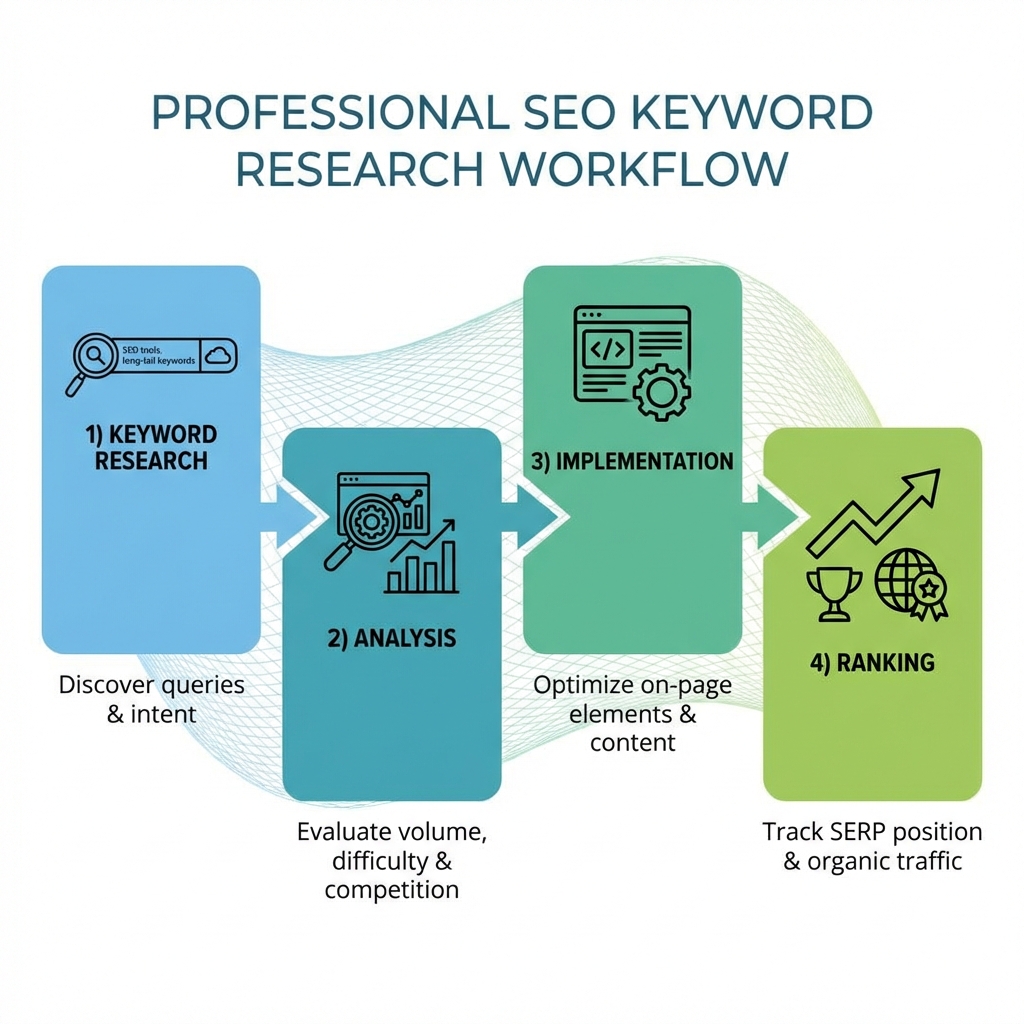
Step 1: Define Your Goals and Audience
Before diving into tools, clarify your objectives. According to Brafton's research methodology, successful keyword research starts with understanding:
- Business goals: Are you focused on brand awareness, lead generation, or direct sales?
- Target audience: Who are they, and what language do they use?
- Content type: Commercial pages require different keywords than informational blogs
Step 2: Generate Seed Keywords
Start with broad "seed" keywords that represent your core topics. These form the foundation for discovering hundreds of related terms. Use:
- Brainstorming: List terms your customers use
- Google Autocomplete: See what Google suggests as you type
- People Also Ask: Identify common questions
- Community forums: Reddit and Quora reveal real user language
Step 3: Expand and Analyze Keyword Ideas
Use keyword research tools to expand your seed list. For each keyword, analyze:
- Search Volume: Monthly search frequency
- Keyword Difficulty (KD): Competition level (aim for KD < 30 for new sites)
- Search Intent: Informational, commercial, navigational, or transactional
- CPC (Cost Per Click): Higher CPC often indicates commercial value
- Trend Data: Is interest growing or declining?
Step 4: Prioritize Strategic Keywords
Not all keywords are created equal. Prioritize based on:
- Relevance to your business
- Realistic ranking potential (considering your site's authority)
- Conversion potential (how likely to drive business results)
- Content gaps where competitors rank but you don't
🚀 Automate Your Keyword Research
Finding low-competition, high-value keywords manually is time-consuming. Our Long Tail Keyword Generator uses advanced KGR (Keyword Golden Ratio) analysis to identify "hidden gem" opportunities that your competitors are missing. Perfect for the research phase of your SEO workflow!
Step 5: Create Topic Clusters
According to modern SEO best practices, organize keywords into topic clusters:
- Pillar content: Broad, comprehensive guides on main topics
- Cluster content: Specific, detailed articles on subtopics
- Internal linking: Connect related content to signal topical authority
Long Tail Keywords vs Short Tail: The Strategic Balance
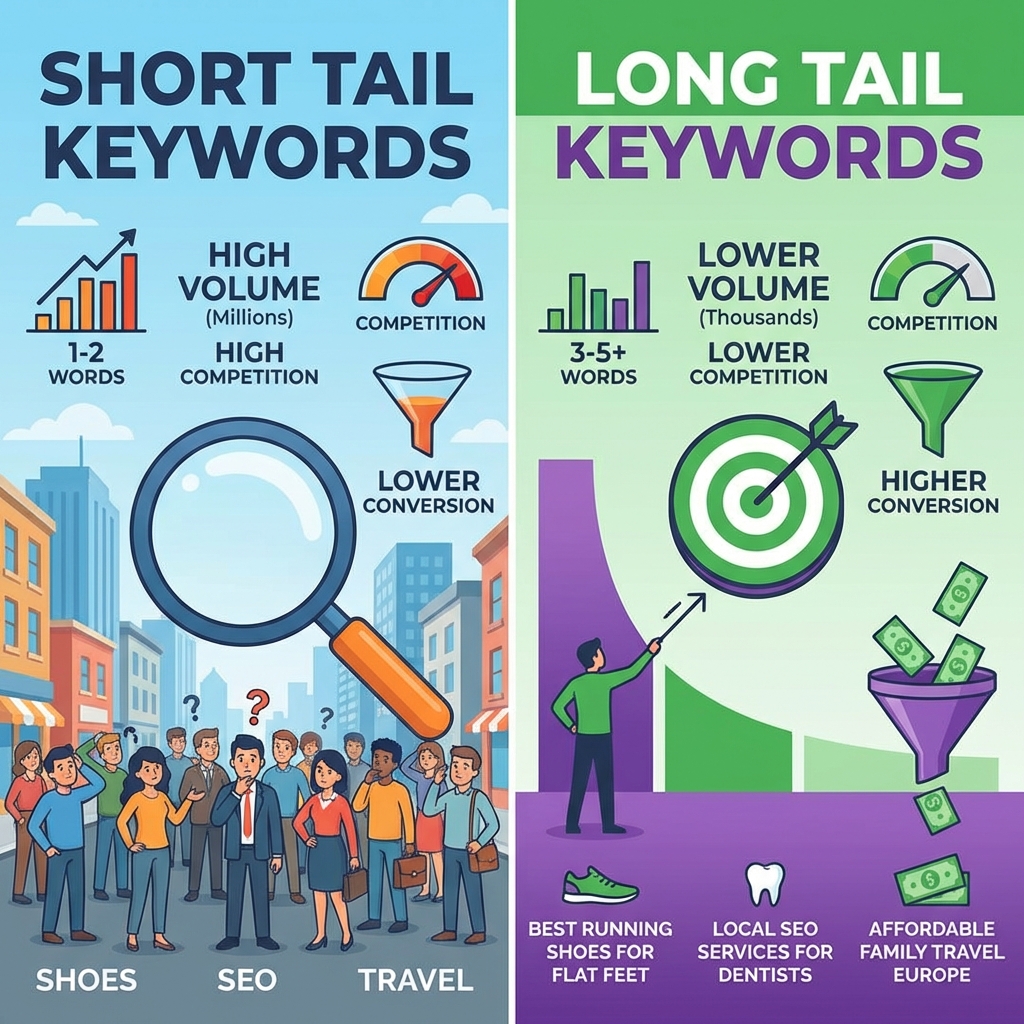
Understanding the difference between long tail keywords vs short tail is crucial for building an effective SEO strategy.
Short-Tail Keywords: The Broad Approach
Short-tail keywords (1-3 words) like "running shoes" or "SEO" are:
| Advantages | Disadvantages |
|---|---|
| High search volume (tens of thousands of searches) | Extremely high competition |
| Broad brand awareness potential | Lower conversion rates (unclear intent) |
| Foundation for keyword research | Difficult for new sites to rank |
| Gateway traffic to your website | Higher bounce rates |
Long-Tail Keywords: The Precise Strategy
Long-tail keywords (3-5+ words) like "best running shoes for flat feet winter" or "how to do SEO for local businesses" are:
| Advantages | Disadvantages |
|---|---|
| Lower competition (easier to rank) | Lower individual search volume |
| Higher conversion rates (specific intent) | Requires more content pieces |
| Targeted, qualified traffic | Less total traffic per keyword |
| Perfect for voice search queries | More research intensive |
The Winning Strategy: Balance Both
According to SEO strategists at HawkSEM, the most effective approach combines both:
- Start with long-tail keywords to build initial traffic and authority
- Create comprehensive content that naturally ranks for related short-tail terms
- Build topical authority over time to compete for broader keywords
- Use short-tail for awareness, long-tail for conversions
📊 Statistical Insight: Research shows that long-tail keywords account for 70% of all search traffic, despite each individual keyword having lower volume. This is why a diversified strategy focusing on multiple long-tail terms often outperforms chasing a single high-volume keyword.
Essential Keyword Search Volume Tools
The right keyword search volume tool can make or break your research process. Here's a comprehensive comparison of the best tools for 2026:
Free Keyword Research Tools
1. Google Keyword Planner
Best for: Validating search demand and discovering keyword variations
- ✅ Direct data from Google (most accurate source)
- ✅ Free to use (requires Google Ads account)
- ✅ Shows CPC and competition data
- ⚠️ Volume ranges instead of exact numbers
- ⚠️ Limited SEO-specific insights
2. Google Search Console
Best for: Analyzing existing performance and finding quick-win opportunities
- ✅ Shows actual queries driving traffic to your site
- ✅ Reveals ranking positions and click-through rates
- ✅ 100% free and highly accurate
- ⚠️ Only shows data for your own website
3. Google Trends
Best for: Understanding search trends and seasonality
- ✅ Tracks keyword popularity over time
- ✅ Shows related queries and topics
- ✅ Geographic interest data
- ⚠️ No absolute search volume numbers
Premium Keyword Research Tools
1. Semrush (Starting at $129.95/month)
Best for: Comprehensive competitive research and intent analysis
According to ContentAnchor's tool comparison, Semrush's Keyword Magic Tool is one of the most powerful options available:
- ✅ 25+ billion keyword database
- ✅ Intent classification (informational, commercial, transactional)
- ✅ SERP feature tracking
- ✅ Keyword clustering by topic
- ✅ Competitor keyword gap analysis
2. Ahrefs Keywords Explorer (Starting at $129/month)
Best for: Competitive SEO and content planning at scale
- ✅ Most extensive backlink index
- ✅ Clickstream data for real click estimates
- ✅ Parent topic identification
- ✅ Global search data across 170+ countries
- ✅ Accurate keyword difficulty scores
3. Moz Keyword Explorer (Starting at $99/month)
Best for: Simplified research for smaller teams
- ✅ Priority score (combines volume, difficulty, CTR)
- ✅ SERP analysis with featured snippet tracking
- ✅ User-friendly interface
- ✅ Organic CTR estimates
4. Ubersuggest (Free + Paid from $12/month)
Best for: Budget-conscious businesses
- ✅ Affordable pricing
- ✅ Comprehensive keyword suggestions
- ✅ Content ideas based on top-performing pages
- ✅ Limited free version available
Specialized Tools
AnswerThePublic
Best for: Finding question-based keywords and content ideas
- ✅ Visualizes questions people ask
- ✅ Perfect for FAQ and blog content
- ✅ Shows prepositions and comparisons
KeywordTool.io
Best for: Long-tail keyword generation across multiple platforms
- ✅ Pulls autocomplete data from Google, YouTube, Amazon, etc.
- ✅ Excellent for niche content ideas
- ✅ Generates 750+ suggestions per search
💰 Cost-Benefit Analysis: For most businesses, starting with free tools (Google Keyword Planner, Search Console, Trends) and adding one premium tool as your SEO efforts scale provides the best ROI. If you can only choose one paid tool, Semrush offers the most comprehensive feature set for the price.
How to Use Keywords in Your Website
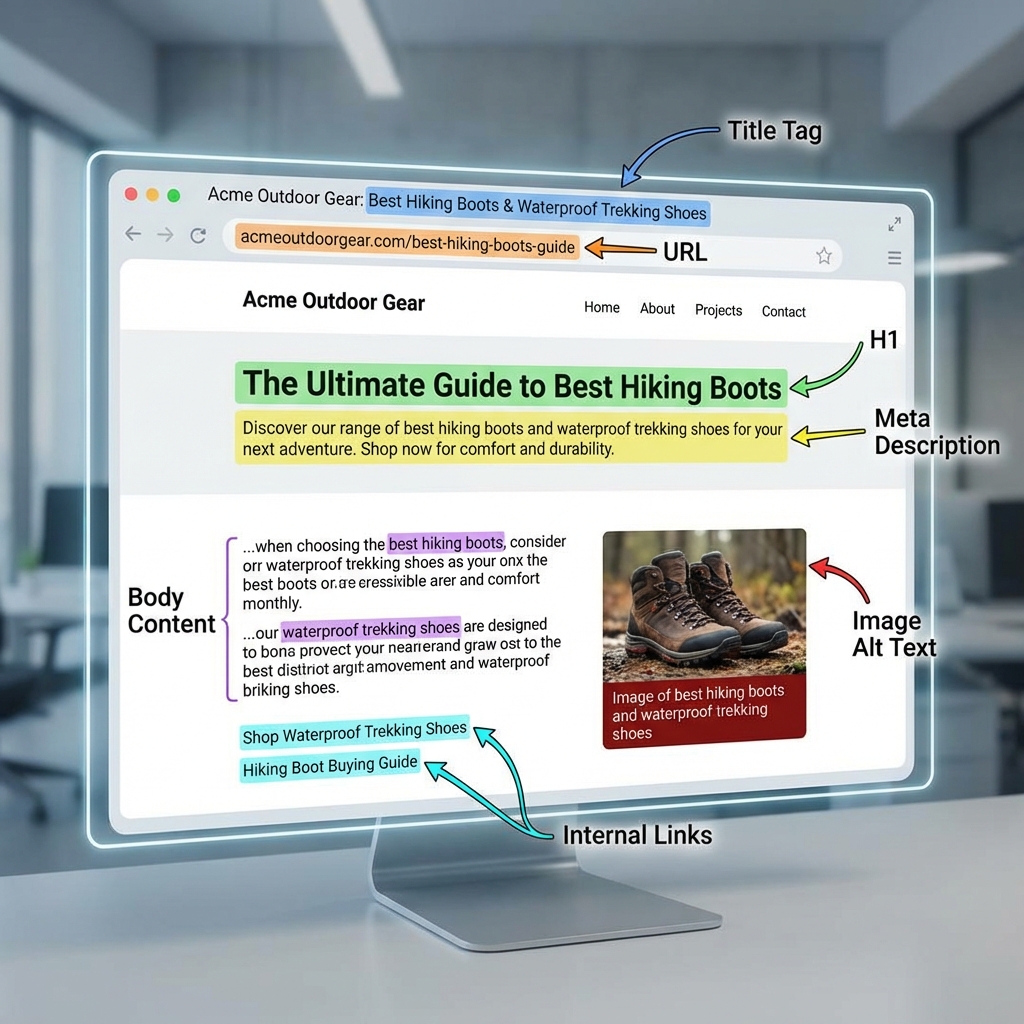
Knowing how to use keywords in website content is just as important as finding the right keywords. The key is strategic placement that signals relevance to search engines while maintaining natural readability for users.
Critical On-Page Keyword Locations
1. Title Tag (Meta Title)
Your page's <title> tag is the single most important on-page SEO element:
- ✅ Include your primary keyword near the beginning
- ✅ Keep it 50-60 characters (to avoid truncation in search results)
- ✅ Make it compelling and click-worthy
- ✅ Example: "Keywords for Search Engine Optimisation: The Ultimate 2026 Guide"
2. H1 Heading
Your main heading should include your primary keyword:
- ✅ Use only ONE H1 per page
- ✅ Make it descriptive and keyword-rich
- ✅ Keep it under 70 characters for best results
3. Meta Description
While not a direct ranking factor, meta descriptions affect click-through rates:
- ✅ Include primary and secondary keywords naturally
- ✅ Write 120-160 characters
- ✅ Create a compelling call-to-action
- ✅ Accurately summarize page content
4. URL Slug
Clean, keyword-rich URLs help both users and search engines:
- ✅ Use hyphens to separate words
- ✅ Keep URLs short and descriptive
- ✅ Include your primary keyword
- ✅ Example:
/blog/keywords-for-search-engine-optimisation
5. First 100-200 Words
According to SurferSEO's content analysis, including your primary keyword early signals immediate relevance:
- ✅ Use primary keyword in the first paragraph
- ✅ Establish context and topic immediately
- ✅ Make it natural—don't force keyword placement
6. Subheadings (H2, H3, H4)
Structure your content with keyword-rich subheadings:
- ✅ Use H2s for main sections (include primary + secondary keywords)
- ✅ Use H3s for subsections (LSI keywords and variations)
- ✅ Maintain logical hierarchy
- ✅ Example H2: "The SEO Keyword Research Process"
7. Body Content
Distribute keywords naturally throughout your text:
- ✅ Aim for 1-2% keyword density (1-2 mentions per 100 words)
- ✅ Use synonyms and variations (LSI keywords)
- ✅ Prioritize readability over exact keyword matching
- ⚠️ Avoid keyword stuffing—it hurts rankings and user experience
8. Image Alt Text
Optimize images for both accessibility and SEO:
- ✅ Describe image content accurately
- ✅ Include relevant keywords naturally
- ✅ Keep alt text concise (125 characters or less)
- ✅ Example:
alt="SEO keyword research workflow diagram showing 4-step process"
9. Internal Link Anchor Text
Link to related content using descriptive, keyword-rich anchor text:
- ✅ Use natural phrases that include keywords
- ✅ Avoid generic "click here" or "learn more"
- ✅ Link to relevant, related content
- ✅ Example: "Learn more about KGR and advanced keyword metrics"
Best Practices for Natural Keyword Integration
⚠️ Critical Warning: In 2026, Google's AI can easily detect keyword stuffing and unnatural language. According to Bruce Clay's SEO guidelines, your content must read naturally and prioritize user experience. If a sentence sounds awkward with a keyword inserted, rewrite it or use a synonym.
- Write for humans first: Your primary goal is to provide value to readers
- Use semantic variations: Don't repeat the exact same keyword—use related terms
- Consider user intent: Different keywords require different content formats
- Update regularly: Refresh content to include new keywords and trending topics
Competitive Keyword Analysis Techniques
Competitive keyword analysis is the process of discovering which keywords your competitors rank for and identifying opportunities to outrank them.
The 5-Step Competitive Analysis Framework
Step 1: Identify Your True SEO Competitors
Your business competitors may not be your SEO competitors. According to SEO Clarity's research, identify websites that:
- Rank for keywords you're targeting
- Compete for visibility in your niche
- Have similar domain authority levels
- Target the same audience demographics
How to find them:
- Search your seed keywords and note top-ranking sites
- Use Semrush or Ahrefs to identify "organic competitors"
- Analyze 3-5 competitors for manageable insights
Step 2: Extract Competitor Keywords
Use SEO tools to discover what keywords drive traffic to competitor sites:
- Semrush Organic Research: Enter competitor domain → view organic keywords
- Ahrefs Site Explorer: Check "Organic keywords" report
- Moz Link Explorer: View ranking keywords
Key metrics to analyze:
- Ranking position (top 3 positions get 75% of clicks)
- Search volume (traffic potential)
- Keyword difficulty (competition level)
- Traffic estimate (actual value delivered)
Step 3: Perform Keyword Gap Analysis
Identify "content gaps"—keywords your competitors rank for, but you don't. This reveals immediate opportunities:
- Semrush Keyword Gap: Compare up to 5 domains
- Ahrefs Content Gap: Find missing keyword opportunities
- Moz Keyword Gap: Focus on attainable keywords
Prioritize gap keywords by:
- Relevance: Does it align with your business?
- Volume: Is there sufficient search demand?
- Difficulty: Can you realistically compete?
- Intent: Does it match your content goals?
Step 4: Analyze Competitor Content Quality
Don't just identify keywords—learn why competitor pages rank well:
- Content depth: How comprehensive is their coverage?
- Word count: Longer content often ranks better (aim for 2000+ words for competitive terms)
- Content structure: Do they use clear headings, lists, images?
- Backlink profile: How many quality links do they have?
- User engagement: Check comments, shares, time on page
Step 5: Identify Vulnerable Rankings
Look for keywords where competitors rank, but their content is weak or outdated:
- Pages with thin content (< 500 words)
- Outdated information (published years ago without updates)
- Poor user experience (slow loading, no mobile optimization)
- Weak backlink profiles
- Missing E-E-A-T signals (no author, no sources)
Create superior content by:
- Providing more comprehensive coverage
- Including updated 2026 data and examples
- Adding visual elements (images, charts, videos)
- Demonstrating expertise and citing authoritative sources
- Optimizing for better user experience
Advanced Competitive Techniques
Track Competitor Keyword Movement
Monitor how competitor rankings change over time:
- Set up rank tracking in Semrush or Ahrefs
- Identify sudden ranking drops (opportunities to overtake)
- Notice new keywords they're targeting
- Quarterly competitive audits to stay updated
Analyze Their Link Building Strategy
Understanding where competitors get backlinks reveals opportunities:
- Use Ahrefs to view their backlink profile
- Identify high-authority linking domains
- Find broken links you can replace
- Discover guest posting opportunities
Study Their PPC Keywords
Keywords competitors pay for often indicate high commercial value:
- Use Semrush or SpyFu to view PPC campaigns
- Identify high-CPC keywords worth targeting organically
- Analyze ad copy for conversion insights
🎯 Need Competitive Analysis Support?
Understanding competitive keyword data is complex. Our comprehensive guide to keyword analysis provides deeper insights into intent-driven ranking strategies and modern competitive techniques.
Advanced Strategies for 2026
As SEO evolves, staying ahead requires implementing cutting-edge strategies that go beyond basic keyword research.
1. Topic Clusters and Pillar Content
Instead of isolated keywords, build comprehensive topic coverage:
- Pillar page: Comprehensive guide on broad topic (e.g., "SEO Guide")
- Cluster content: Detailed articles on specific subtopics (e.g., "Keywords for Search Engine Optimisation," "Link Building," "Technical SEO")
- Internal linking: Connect all cluster content to the pillar page
- Benefit: Signals topical authority to search engines
2. AI and Conversational Search Optimization
With the rise of AI assistants and voice search, optimize for natural language:
- Target question-based keywords ("How do I...?", "What is...?")
- Use conversational, natural phrasing
- Structure content to answer specific questions
- Optimize for featured snippets (position zero)
3. Search Intent Optimization
Different keywords require different content formats:
- Informational: Blog posts, guides, tutorials
- Commercial: Comparison pages, reviews, "best of" lists
- Transactional: Product pages, pricing pages, signup forms
- Navigational: Brand pages, contact pages
4. Semantic SEO and LSI Keywords
Use semantically related terms to add context and depth:
- Include synonyms and variations of your primary keyword
- Cover related concepts and entities
- Answer related questions users might have
- Tools: Use LSI Graph or Google's "Related Searches"
5. SERP Feature Optimization
Target specific SERP features for increased visibility:
- Featured Snippets: Answer questions concisely in 40-60 words
- People Also Ask: Address related questions in your content
- Knowledge Panels: Use structured data markup
- Local Packs: Optimize Google Business Profile for local keywords
6. Video and Multi-Modal Content
Search is increasingly multi-modal:
- Create video content targeting the same keywords
- Optimize YouTube descriptions and transcripts
- Embed videos in blog posts for richer content
- Use image SEO for visual search opportunities
7. Regular Content Audits and Updates
Keep content fresh and relevant:
- Audit top-performing pages quarterly
- Update statistics and examples
- Add new keywords and trending topics
- Improve thin or underperforming content
- Remove or consolidate outdated pages
🚀 2026 Trend Alert: Google's AI Overviews (formerly SGE) are changing how users interact with search results. To stay visible, focus on comprehensive, authoritative content that's cited in AI summaries. This means demonstrating E-E-A-T through expert authorship, original research, and citing high-quality sources.
Conclusion
Mastering keywords for search engine optimisation in 2026 requires more than just finding high-volume terms. Success comes from understanding the complete journey from research to ranking:
- ✅ Research strategically: Use the 5-step keyword research process to identify opportunities
- ✅ Balance your strategy: Combine long-tail and short-tail keywords for maximum impact
- ✅ Use the right tools: Invest in quality keyword research tools that match your needs
- ✅ Optimize thoughtfully: Place keywords strategically while prioritizing user experience
- ✅ Outcompete smartly: Use competitive analysis to find gaps and opportunities
- ✅ Stay current: Adapt to AI search, voice queries, and evolving SERP features
Remember, the SEO keyword research process is not a one-time task—it's an ongoing cycle of research, implementation, monitoring, and refinement. By following the strategies outlined in this guide and staying committed to creating genuinely helpful content that demonstrates expertise, you'll build sustainable organic visibility that drives real business results.
Start implementing these techniques today. Audit your current keyword strategy, identify gaps, and create a roadmap for comprehensive topic coverage. The competition is fierce, but with the right approach, you can dominate your niche in 2026 and beyond.
🎯 Ready to Put This Into Practice?
Don't let valuable keyword opportunities slip away. Try our Long Tail Keyword Generator to discover untapped keywords your competitors are missing. Plus, explore our other SEO resources:
About the Author: This guide was created by SEO experts with over a decade of experience in keyword research and organic search optimization. All recommendations are based on authoritative industry sources, current best practices, and real-world testing.